
Artificial intelligence is reshaping management education, prompting business schools such as IIM Kozhikode, IIM Lucknow, ISB and BITSoM to overhaul MBA programmes
New Delhi: Artificial intelligence (AI) is upending the Master of Business Administration (MBA), and business schools are rushing to adapt.
As AI automates many of the core technical skills traditionally taught in these elite programmes, institutions are reinventing the degree to draw up a blueprint for the next generation of leaders.
Also Read: AI is entering the boardroom, warehouse, and checkout. Are businesses ready?
Freshly minted MBA graduates are now expected to build AI agents, question machine recommendations and take responsibility for the outcomes. They work through business problems alongside machines, then navigate the complex human aspects of the business.
Also Read: Nearly 90% students prioritise skills over degrees, reveals a survey
 At BITSoM, every MBA student is required to build an AI agent. The exercise puts students in the position of creating something that works, taking them beyond discussing what technology might do.
The school integrates AI across business functions, from operations and decision-making to marketing and customer engagement, according to Saravanan Kesavan, dean and professor of operations at BITSoM. "Rather than treating AI as a standalone subject, BITSoM integrates it across the curriculum, helping students understand how it is transforming every business function, from decision-making and operations to marketing and customer engagement," he said.
Students also work alongside startups through BITSoM VERTEX, an AI venture incubator developed with Silicon Valley innovation studio LENZ. "Business schools need to shift the balance from teaching about management to helping people learn to manage," said Madan Pillutla, dean, ISB.
For young graduates, the stakes are particularly high. The routine work that AI can absorb has also traditionally been done at the entry level. "For fresh graduates, the case for business school may strengthen as AI absorbs routine work through which they once learned how organisations function," added Pillutla.
IIM Lucknow says it is attuning to the AI-driven future of work and has taken steps including faculty recruitment in the field of AI and cybersecurity, training and development of existing faculty and staff, the launch of new programmes in AI and data analytics at undergraduate and postgraduate levels, as well as the integration of various optional courses in AI for MBA students.
"We're also working on setting up AI labs for students," said Arunabha Mukhopadhyay, professor of IT and systems at IIM Lucknow.
The institute has started integrating AI across the MBA curriculum. "The focus is to help students make responsible business decisions using AI. Our aim is to make students capable enough to work effectively with AI in their organisations." IIM Kozhikode is embedding AI literacy, analytical decision-making and digital strategy into management education. It is also rethinking what assignments should test. "AI skills are tools; wisdom in applying them is what creates value," said Chatterjee.
For instance, at Nanyang Business School, Singapore, MBA students exploring retail transformation through agentic AI and digital twins had to look beyond technological possibilities to commercial viability, customer experience, trust and implementation.
AI could generate options. Students still had to determine which would work, for whom and at what cost, said dean Jun Yang. "AI is not making the MBA obsolete. It is making an MBA built primarily around knowledge transmission obsolete," she added.
As AI automates many of the core technical skills traditionally taught in these elite programmes, institutions are reinventing the degree to draw up a blueprint for the next generation of leaders.
Also Read: AI is entering the boardroom, warehouse, and checkout. Are businesses ready?
Freshly minted MBA graduates are now expected to build AI agents, question machine recommendations and take responsibility for the outcomes. They work through business problems alongside machines, then navigate the complex human aspects of the business.
Who's leading the charge
Business schools-including Indian Institute of Management (IIM) Kozhikode, IIM Lucknow, Indian School of Business (ISB), BITS School of Management (BITSoM), and global players like Nanyang Business School-are responding through changes in curriculum, practical learning and assessment, according to institution officials.Also Read: Nearly 90% students prioritise skills over degrees, reveals a survey
'Profound transformation'
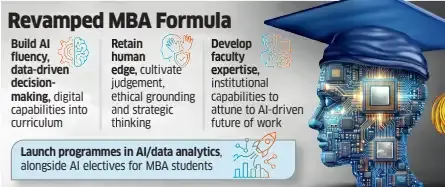
"Management education is undergoing a profound transformation, driven by advances in artificial intelligence and data science. We are working to embed AI literacy, data-driven decision-making and digital strategy into management education, while ensuring that our graduates develop the judgement, ethical grounding and strategic thinking required to lead in an AI-augmented world," said Debashis Chatterjee, director, IIM Kozhikode.The school integrates AI across business functions, from operations and decision-making to marketing and customer engagement, according to Saravanan Kesavan, dean and professor of operations at BITSoM. "Rather than treating AI as a standalone subject, BITSoM integrates it across the curriculum, helping students understand how it is transforming every business function, from decision-making and operations to marketing and customer engagement," he said.
Students also work alongside startups through BITSoM VERTEX, an AI venture incubator developed with Silicon Valley innovation studio LENZ. "Business schools need to shift the balance from teaching about management to helping people learn to manage," said Madan Pillutla, dean, ISB.
For young graduates, the stakes are particularly high. The routine work that AI can absorb has also traditionally been done at the entry level. "For fresh graduates, the case for business school may strengthen as AI absorbs routine work through which they once learned how organisations function," added Pillutla.
IIM Lucknow says it is attuning to the AI-driven future of work and has taken steps including faculty recruitment in the field of AI and cybersecurity, training and development of existing faculty and staff, the launch of new programmes in AI and data analytics at undergraduate and postgraduate levels, as well as the integration of various optional courses in AI for MBA students.
"We're also working on setting up AI labs for students," said Arunabha Mukhopadhyay, professor of IT and systems at IIM Lucknow.
The institute has started integrating AI across the MBA curriculum. "The focus is to help students make responsible business decisions using AI. Our aim is to make students capable enough to work effectively with AI in their organisations." IIM Kozhikode is embedding AI literacy, analytical decision-making and digital strategy into management education. It is also rethinking what assignments should test. "AI skills are tools; wisdom in applying them is what creates value," said Chatterjee.
For instance, at Nanyang Business School, Singapore, MBA students exploring retail transformation through agentic AI and digital twins had to look beyond technological possibilities to commercial viability, customer experience, trust and implementation.
AI could generate options. Students still had to determine which would work, for whom and at what cost, said dean Jun Yang. "AI is not making the MBA obsolete. It is making an MBA built primarily around knowledge transmission obsolete," she added.