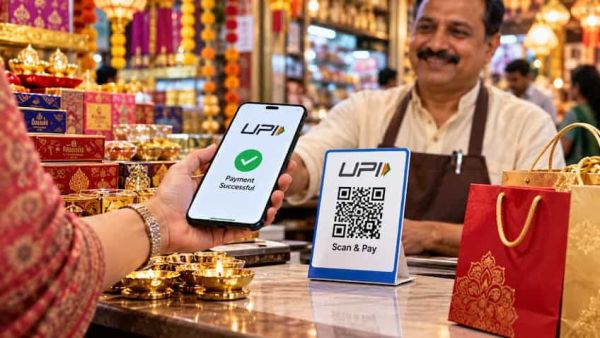
On the cusp of the festive season for retail traders, MSME sector and crores of digital consumers across the country, a big relief news has come from the Central Government and the National Payments Corporation of India (NPCI). The decision to implement the proposed 0.4 percent merchant discount rate (MDR) on UPI merchant payments worth more than ₹2,000 from October 15, 2026, has been formally postponed to Diwali. NPCI's steering committee, after its meeting on Tuesday, October 13, clarified that this step has been taken in view of the peak period of festive shopping. After this postponement, digital purchases worth crores of rupees made in markets across the country during major festivals like Karva Chauth, Dhanteras, Diwali and Chhath Puja will continue completely uninterrupted without any additional service charge or merchant deduction. What was the full proposal of 0.4% MDR on UPI payments above ₹2,000 The plan to levy the charge on select person-to-merchant (P2M) transactions from October 15 was drawn up under a prior order of NPCI. The proposal had three key provisions: First, if a customer makes a payment of more than ₹2,000 to a merchant through UPI, an MDR of 0.4% will be deducted from the merchant's account on that transaction. For example, the fee for a bill of ₹2,500 was ₹10, for a bill of ₹5,000 it was ₹20 and for a payment of ₹10,000 it was ₹40. Second, a maximum flat cap of ₹300 was fixed instead of a percentage on large transactions of ₹75,000 or more. Third, a nominal flat charge of ₹5 per transaction was proposed in essential sectors such as railways, petrol pumps, telecom and insurance. However, NPCI and the Finance Ministry had also made it clear that it will not have any impact on the common man sending money from one account to another (P2P transfer) and 96% of small transactions. Trade organization CAIT called the decision a 'timely and practical step'. Major trade unions across the country, including the Confederation of All India Traders (CAIT), have welcomed this decision of the government and NPCI wholeheartedly. Praveen Khandelwal, MP from Chandni Chowk and National General Secretary of CAT, issued a statement saying that this decision is a great support for crores of small and medium businessmen of the country. Traders argued that Diwali and wedding season are the times of the year when retailers do 40 to 50 percent of their annual business. Implementing a new charge at such a critical time would not only create technical and billing confusion at the shops, but would also have a direct impact on the profits of grocery, textile and electronics traders operating on low margins. Expressing gratitude to Finance Minister Nirmala Sitharaman, business organizations said that the government has strengthened the confidence of the business community by understanding the ground reality. Record surge in digital payments expected during festive shopping Between October and December, India's retail market witnesses huge purchases of gold jewellery, new vehicles, apparel, gifts and home electronic appliances. There are currently over 55 crore active UPI users in the country and billions of transactions worth over ₹20 lakh crore to ₹29 lakh crore happen on the network every month. According to retail market data, in terms of numbers, payments above ₹2,000 may constitute only 4 to 5 per cent of the total volume, but 65 to 67 per cent of the total transaction value comes from these large transactions. If the 0.4% cut was triggered during the festive season, many shopkeepers would start demanding cash payments from customers, which would risk slowing down the pace of Digital India. Now with the postponement of the decision, consumers will be able to easily make big purchases by scanning the QR code without any hesitation. Banks and fintech companies will get additional time to prepare the system. This decision has not only provided technical relief to the merchants but also to major banks and payment aggregators including PhonePe, Google Pay, Paytm. Under the rules of MDR, 40% of the fee collected is to be shared between the customer's bank, 30% payment gateway, 20% UPI app and 10% sponsor bank. Financial experts believe fintech companies desperately needed an extra few weeks of time to classify accounts of lakhs of merchants, identify merchants with turnover of more than ₹1 lakh in 3 consecutive months and update settlement software. By getting this time, the backend infrastructure can now be strengthened without any technical glitches. When can the new rule come into effect after Diwali? NPCI has also made it clear that this decision is not to cancel the scheme, but only to extend (postpone) it till Diwali. In the year 2026, Diwali will be celebrated on 8 November. In such a situation, NPCI is likely to announce the revised date by issuing a new notification in the second fortnight of November. However, trade organizations say that in the meantime they will present their case before the government so that the threshold limit for small shopkeepers can be further increased or alternative arrangements can be considered. At present, the festive market has returned and the pace of digital payments will remain fast without any interruption in the markets and markets across the country.
Contact to : xlf550402@gmail.com
Copyright © boyuanhulian 2020 - 2023. All Right Reserved.