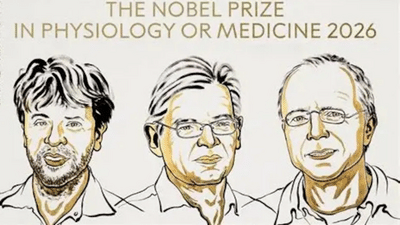
"There is a big picture that brings it all into relief, and my hope is that we can increase empathy and understanding," said Karl Deisseroth , after winning the 2026 Nobel Prize in Physiology or Medicine. It is a rare sentence for a scientist to say. He shares this year's Medicine prize with Peter Hegemann and Georg Nagel for optogenetics - a technique that lets us switch individual nerve cells on and off with light.But his journey did not begin in a laser lab. It began as a medical student in a psychiatric ward, watching human suffering and wondering: How can one brain experience the same world so differently from another? That question is not new. It is Vedic.
"Tamaso Ma Jyotir Gamaya"Our Upanishads have always said that consciousness is light. "Prajnanam Brahma" - Consciousness is Brahman. For centuries, the famous prayer, "Lead me from darkness to light," was a metaphor for knowledge. Optogenetics has made it literal.
For the first time, we can take a living brain, identify the tiny cluster of neurons that holds a specific memory, a specific fear, a specific feeling of loneliness - and illuminate it. We can turn on joy. We can dim anxiety. Not with philosophy, but with a precise beam of light.
What our rishis called "Antah Prakasha" — the inner light — neuroscience can now see and touch.
Why Empathy Fails, and How Light HelpsThe Gita instructs us: "Atmavat Sarva Bhuteshu" — See yourself in all other beings. Yet we fail at it every day. Why? Because empathy isn't just a moral choice. It is a neural circuit.
A child who grew up in fear has an amygdala that fires like an alarm at the slightest trigger. Another who grew up in safety has prefrontal circuits that calmly contextualise. Both are looking at the same person, but their brains are living in different worlds.When Deisseroth says he wants to increase empathy, he means this: Once you see the circuit that makes a person act the way they do, judgment disappears. You no longer see a "difficult person." You see a circuit trapped in darkness, waiting for light.
As an endocrinologist, I see this daily. Cortisol is not just a hormone; it is embodied anxiety. Oxytocin is not just a peptide; it is trust made liquid. But these chemicals do not act alone. Neural rhythms govern them, and they, in turn, respond to light and silence. In the deepest stages of rest, when external light and sound fall to zero, the brain does not shut down - it repairs. Melatonin rises, autophagy begins, the default mode network integrates memory and emotion. Creation, truly, thrives in stillness.We were never meant to be always on.
Ekam Sat, Many LightsOptogenetics is already moving from lab to clinic. In patients blinded by retinitis pigmentosa, researchers are placing light-sensitive proteins from algae into the retina. When light shines, they see again. Light restores light. The Chandogya Upanishad says, "Ekam Sat Vipra Bahudha Vadanti", Truth is one; sages call it by many names.
Science calls it a channelrhodopsin. The Vedas called it "Jyoti". Both point to the same big picture: within each of us, there is a lamp that can be relit.The real miracle of the 2026 Nobel Prize is not that we can control the brain with light. It is that we finally have a tool to prove what compassion has always known - that behind every behaviour is a story, behind every story is a circuit, and behind every circuit is a human being waiting to be understood, not judged. If we can switch on a neuron with light, perhaps we can also switch on empathy in humanity. That would be the truest healing.
Authored by: Shashank Joshi
Contact to : xlf550402@gmail.com
Copyright © boyuanhulian 2020 - 2023. All Right Reserved.