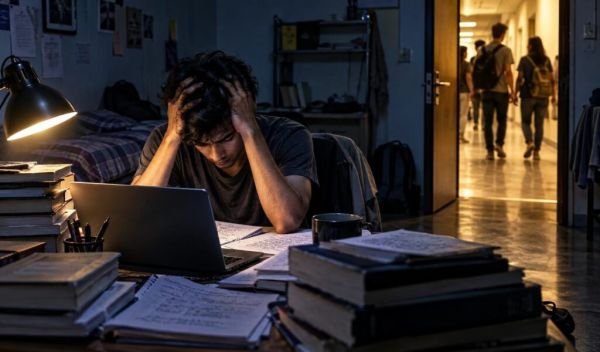
India’s premier institutes must confront academic pressure, isolation and discrimination before distress turns into tragedy
Published Date – 21 September 2026, 01:23 AM
How many more young students should end their lives on campuses before the nation wakes up to this humongous crisis created by an uncaring and merciless system? The recent suicide of a second-year engineering student at IIT Bombay has stirred up a debate on the loopholes in the existing setup meant to prevent student suicides. This was the third death at the prestigious technology institute in the last seven months. In February, a second-year student died by suicide in his hostel room on the institute’s Powai campus. In July, a 20-year-old student similarly took his own life. There are allegations that caste-based harassment had prompted Sahil Wakode, a 20-year-old Dalit from Bihar, to resort to the extreme step. The institute, on the other hand, has claimed that he was caught copying in an examination using an AI tool, but no disciplinary action was initiated against him. Hours later, he was found dead in his hostel room. The incident triggered spontaneous protests by students demanding the resignation of the director of IIT Bombay. Four student suicides across IIT campuses at Bombay, Delhi, Kharagpur and Guwahati in the last three weeks expose the failure of the suicide prevention measures at these institutes. No lessons are learned from past tragedies as there are continued concerns on a range of issues, from mental health problems to academic pressure, institutional practices, discrimination, and an unforgiving campus environment. There is a growing realisation that counselling and wellness measures alone may not adequately address the crisis.
Every death on the campus must be seen as a cry in the wilderness; a silent scream that should haunt us collectively as a nation. After acing one of the toughest competitive tests in the world, students step into these hallowed campuses, dreamy-eyed and full of hope and optimism, but what they eventually go through on IIT campuses during this crucial phase is something that society never bothers to find out. An unreasonable level of competition, intense parental and societal pressure, fear of falling behind academically or in placements, uncertainty about employment, social isolation, loneliness, and perceived discrimination are all inter- issues that need urgent attention. An institutional culture that disproportionately recognises high performers may further leave struggling students feeling invisible. These pressures can contribute to inadequacy, exclusion, and loss of belonging — signals that a procedural support system may not detect early enough. IITs have counselling, mentoring, helplines, and wellness programmes, but support that becomes visible only after distress is not prevention. What is needed is an integrated early-warning system involving teachers, mentors, parents, roommates, wing-mates, and close friends to recognise academic decline, behavioural changes, withdrawal, or unusual anxiety. There is also a need to reform the assessment system because a ‘one-size-fits-all’ principle will not do justice to students. Flexible academics can provide different pathways for students with variable learning abilities.
Contact to : xlf550402@gmail.com
Copyright © boyuanhulian 2020 - 2023. All Right Reserved.