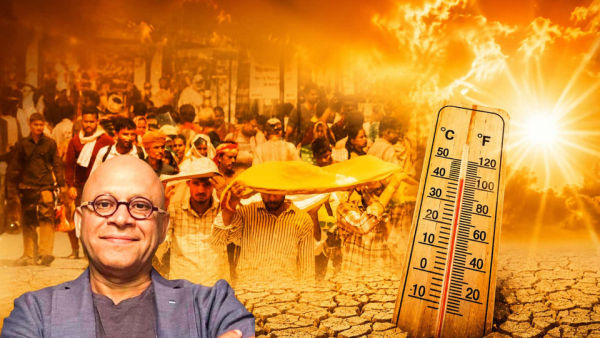
As Indian summers are turning more brutal with heat waves no longer confined to just high temperatures, experts have weighed in on such extreme climatic conditions. The country has seen quite a few deaths caused by heat in recent times, and its power and health sectors have been under strain.
Also read: World’s heat capital: Why India is becoming the hottest place on Earth
As India grapples with prolonged heatwaves and warmer nights, The Federal spoke with climate scientist, Professor Raghu Murtugudde, on why summer temperatures in India feel more relentless than before, the role of humidity and urbanisation, and what lies ahead.
According to him, rising humidity, expanding cities, and global warming are combining to make Indian summers increasingly unbearable.
Here are some excerpts from the interview:
India has always had heatwaves. But why do they now feel far more brutal than in earlier decades?
We have always had a heatwave season in March, April, and May. But what is happening now is that there is background warming, global warming, which has a seasonal imprint on India.
Not all seasons warm equally. During the monsoon, India is not warming in the same way because of certain dynamic reasons. But this additional warming on top of the seasonal warming we normally expect from winter to summer is making conditions much harsher.
Also read: PM Modi advises people to stay hydrated amid rising temperatures across India
March, April, and May are technically spring months for many countries, but in India, they are our hottest months. When temperatures rise further, humidity also increases because a warmer atmosphere is a thirstier atmosphere and can hold much more moisture.
One degree Celsius of warming can lead to a seven per cent increase in humidity. High humidity feels oppressive because the body loses heat through sweating, and if the atmosphere is already humid, sweat cannot evaporate efficiently.
That is why even a fan may not provide relief — it simply circulates warm, humid air. Heatwaves are becoming more frequent, lasting longer, becoming more intense, and covering larger areas. This is why people are experiencing climate change firsthand.
Is this increased intensity real, or is it partly perception shaped by better reporting and awareness?
Better reporting may help document these events, but you can see the evidence in the number of people being hospitalised and dying due to heatwaves.
Young children, elderly people, and pregnant women are suffering. Even sitting in the shade can feel unbearable when it is hot and humid.
These are not just perceptions. These are real experiences, and they have to be taken seriously.
We are seeing animals like goats and dogs struggling in extreme heat. How can they be protected?
Herders usually rest during the afternoon, and animals tend to seek shade. But many goats have thick fur that is not shaved, which worsens heat stress.
If humans are feeling more heat, animals are also suffering. In many grazing areas, water bodies may not be nearby, especially in hills and pastures.
The challenge is that herders may not easily receive early warnings from the India Meteorological Department or local agencies. We need systems that can communicate clearly to them when temperatures are expected to become dangerously high.
They may need to change grazing timings — perhaps earlier in the morning or later in the evening. But they also have to worry about predators and safety. Traditional routines may now have to change because of the increasing heat during midday.
Why are nighttime temperatures becoming such a critical part of India’s heat crisis, especially in big cities?
At night, people are trying to sleep, so they notice the heat much more than during the day when they are busy working or travelling.
But there is also a scientific reason. Nighttime temperatures are increasing faster because thermal energy is not escaping efficiently into space.
Also read: India under heat dome: Early April surge pushes many regions towards 40°C mark
In cities, buildings are packed closely together, and heat bounces between buildings, roads, and streets. Paved surfaces continue radiating heat even after sunset.
If there are clouds, especially during pre-monsoon months, they trap additional heat. Humidity also acts like a greenhouse gas and traps warmth.
So overall, nighttime temperatures are warming faster than daytime maximum temperatures, even though nights remain cooler than daytime.
Chennai experienced unusually cold weather earlier this year. Is there any connection between these extreme seasonal swings and the intense summer heat now?
When southern cities like Chennai become unusually cold during winter, it is often linked to La Niña conditions in the tropical Pacific Ocean.
There are El Niño and La Niña phases. During El Niño, the tropical Pacific becomes warmer. During La Niña, it becomes cooler.
Also read: Andhra’s Markapur heat surge signals new climate hotspot
Indian winters are strongly influenced by these patterns. During La Niña, pressure systems allow cold air from northern India to travel much further south, reaching places like Chennai, Ooty, and Mahabaleshwar.
These are natural climate variations, but they alter seasonal weather patterns significantly across India.
Are Indian cities amplifying heat through the urban heat-island effect?
Yes, the urban heat-island effect is real. But studies from IIT Bombay have shown that rural regions in India are also experiencing similar warming effects.
In many places, farmers cultivate only one crop season and leave the land fallow during the Rabi season. Without vegetation or moisture, the soil becomes extremely hot.
So, while cities face urban heat island effects because of concrete and dense construction, abandoned agricultural land without tree cover or irrigation can also intensify heat.
When people say ‘it doesn’t cool down anymore’, what has changed in the interaction between land, buildings, and climate?
Urbanisation in India is relentless, and population density in cities is extremely high.
People move to cities for jobs, but many of those jobs involve outdoor work — delivery workers, construction labourers, street vendors, and transport workers.
Many people also live in informal settlements where they lack access to water, electricity, fans, or air conditioning.
As cities expand, more areas are paved over. Natural cooling through evaporation from water bodies disappears. Tree cover and green spaces are being reduced.
Also read: Two Indias, one weather: Heatwaves scorch North while rain drenches South
At the same time, hotter weather increases online food orders, which forces delivery workers to spend more time outdoors in dangerous conditions.
It becomes a deadly combination of rising temperatures, rising humidity, expanding cities, and growing exposure.
How much of the worsening discomfort in coastal cities is due to humidity rather than just temperature?
Humidity depends on temperature because warmer air can hold more moisture.
Along the east coast, the Bay of Bengal brings moisture into coastal states and sometimes deep into northern India. Along the west coast, too, humidity levels remain very high.
The Middle East is also warming rapidly, and deserts warm faster under global warming. This changes pressure gradients and shifts wind patterns over the Arabian Sea.
As a result, rainfall patterns are shifting. Kerala may get less monsoon rainfall, while northwestern regions receive more.
But during the pre-monsoon season, these same circulation changes can bring more heat and humidity from the Arabian Sea into India.
We are also seeing unseasonal rains, crop damage, and increasing heatwave mortality. Oceans are warming, atmospheric circulation is shifting, and people are essentially being cooked.
What should people do to protect themselves, and will future heatwaves become even worse?
As long as greenhouse gas emissions continue increasing, these effects will continue to intensify.
The duration, intensity, frequency, and scale of heatwaves will keep increasing.
The government has developed strong early warning systems, and agencies like the National Disaster Management Authority are working with states to reduce risks.
But we need adaptation measures — more forests, green cover, shelters, hydration centres, and stronger public health systems.
People also need to pay attention to official warnings. Elderly people, children, and those with health conditions are especially vulnerable.
Parents must be careful about children playing outdoors during peak heat. Elderly people must avoid unnecessary exposure. People should know where the nearest hospitals and cooling shelters are.
These may sound like simple precautions, but they are critical. Governments can issue warnings, but individuals must also make informed decisions.
The content above has been transcribed from video using a fine-tuned AI model. To ensure accuracy, quality, and editorial integrity, we employ a Human-In-The-Loop (HITL) process. While AI assists in creating the initial draft, our experienced editorial team carefully reviews, edits, and refines the content before publication. At The Federal, we combine the efficiency of AI with the expertise of human editors to deliver reliable and insightful journalism.
Contact to : xlf550402@gmail.com
Copyright © boyuanhulian 2020 - 2023. All Right Reserved.